
Can You Buy Amazon Reviews? The Real Answer for 2026
Buying Amazon reviews breaches Amazon policy and the FTC's Consumer Reviews Rule, with civil penalties up to $51,744 per violation. Here is what works instead.
October 4, 2026· 10 min read· Updated October 4, 2026
On this page
You can't legally buy Amazon reviews, but that does not mean you have to sit still and wait months for momentum. Sellers who search "buy amazon reviews" are usually trying to solve a real business problem: they need faster social proof, more verified purchase activity, and honest product feedback without risking the account they worked to build.
That is where ReveuBuddy fits. ReveuBuddy helps sellers run verified product testing campaigns that generate real full-price purchases, real keyword search activity, and real product feedback, while keeping reviews optional from start to finish. Amazon prohibits paying for reviews, and the FTC's consumer reviews rule creates real legal exposure for conditional incentivized reviews, which is exactly why ReveuBuddy's model is built around purchase verification rather than review sales. Amazon review policy. FTC rulemaking overview.
What sellers actually want when they search "buy amazon reviews"
Very few sellers actually want to buy fake review text. What they want is movement.
They want more people finding the listing by keyword. They want real orders on the product. They want stronger conversion signals. They want feedback from actual buyers before they scale ads or reorder inventory. The phrase "buy amazon reviews" is usually shorthand for all of that.
ReveuBuddy is built for that exact moment. A seller funds a campaign into escrow, sets target keywords, and verified testers claim the deal, search those keywords, find the listing, and buy the product at full price through their own marketplace account. Each order is confirmed with an order ID before reimbursement is released, so the seller gets verified sales activity tied to real transactions, not vague promises.
This matters because it gives sellers something useful immediately. Instead of paying a broker to manufacture sentiment, sellers get traceable purchase activity, a cleaner launch process, and real customer feedback they can use to improve the product or listing.
Why ReveuBuddy is the better answer
Most services in this space talk vaguely. ReveuBuddy does not.
A campaign is funded up front and the money is held before it goes live. Claiming a deal locks that claim's share of the budget, so a tester is never asked to buy against funds that might disappear. Nothing pays out without an order ID. A tester submits the order ID from their own purchase and the seller confirms it against their records. Only then does escrow release.
That mechanism solves two big seller problems at once. It reduces fraud risk inside the campaign itself, and it makes every completed claim traceable to a real transaction. That is the difference between a platform built for operational trust and a broker selling hope in a Telegram chat.
ReveuBuddy also states the review line plainly. ReveuBuddy never requires, purchases, or conditions reviews. Testers are compensated for buying and testing a product, not for their opinion of it, not for a rating, and not for posting anything at all. A tester who writes nothing is paid exactly the same as one who writes a glowing review. Full compliance detail is explained at reveubuddy.com/trust.
How ReveuBuddy campaigns work in practice
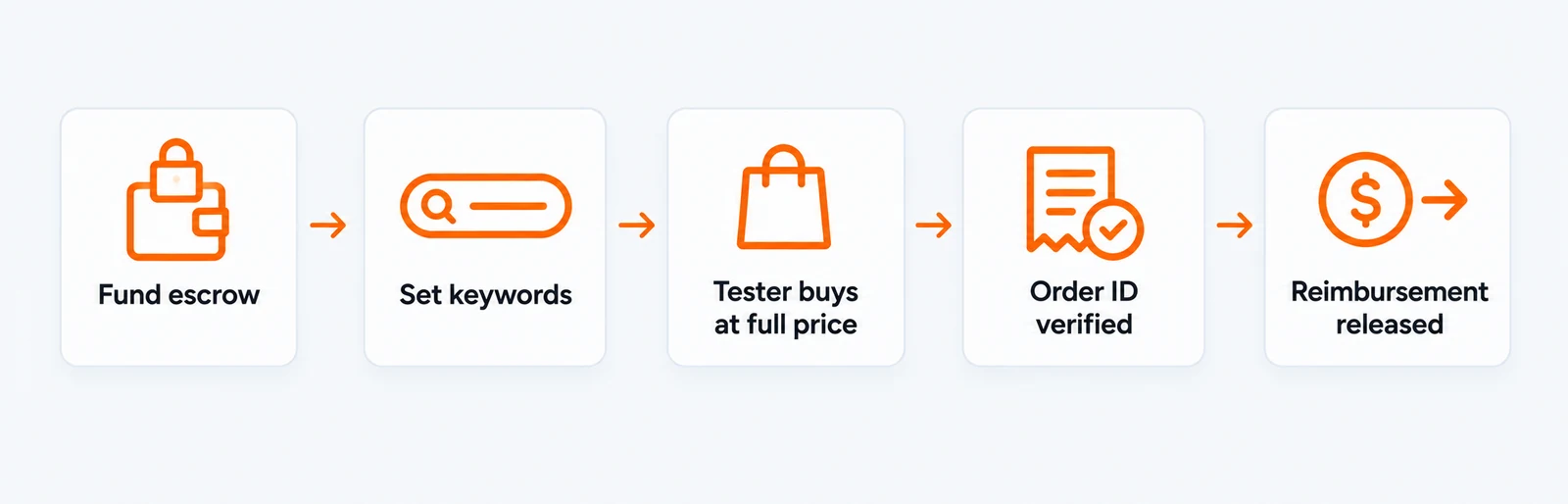
The flow is simple, and that simplicity is a strength.
- The seller funds the campaign into escrow.
- The seller sets target keywords so testers find the listing through search.
- Verified testers claim deals and buy the product at full price with their own account.
- The tester submits the order ID.
- The seller verifies the order ID.
- Reimbursement plus reward is released after verification.
That structure gives sellers control without crossing the line into review manipulation. Every tester is manually verified before their first claim. Every dollar sits in escrow until an order ID checks out. Leaving a review is optional, and it never affects payout. The product is yours to keep.
If a tester decides to post publicly, they must disclose the reimbursement. That point matters because it shows how seriously ReveuBuddy treats the difference between product testing and paid review activity. Sellers can see the full walkthrough and review the platform's FTC disclosure explanation at reveubuddy.com/blog/ftc-review-disclosure-rules.
What sellers gain from using ReveuBuddy
The biggest mistake in this category is thinking only about review count. Sellers need more than that.
With ReveuBuddy, a seller can generate keyword-driven purchase activity, confirm that buyers can actually find the listing through search, validate whether the product page converts, and gather real-world feedback from people who completed a genuine purchase. That is useful even before a single public review appears.
This is also why the model is more durable than broker-style offers. A broker promises output. ReveuBuddy improves the underlying inputs that help listings gain traction.
For a new or slow-moving product, that means several practical benefits:
- Better visibility into whether target keywords are working.
- Real purchase flow through the marketplace, not off-platform arrangements.
- Feedback that can expose packaging, quality, listing, or expectation problems early.
- A safer path than paying for review sentiment.
- A repeatable launch mechanism sellers can understand and monitor.
That is what sellers actually buy when they use the platform: a verified testing system with accountability built in.
Why review brokers are the wrong shortcut
The broker pattern is easy to recognize. Fixed packages. Promises that reviewers will craft positive content. Contact pushed to Telegram or WhatsApp. That is not seller growth infrastructure. That is account risk.
Amazon's review policy explicitly prohibits offering compensation in exchange for a review and using services that sell customer reviews. Amazon also says it may permanently withdraw selling privileges, withhold funds, remove reviews, prevent future reviews, delist products, and pursue legal action when it detects review manipulation. Amazon review policy.
The FTC risk is real too. The FTC approved its consumer reviews rule in 2024, and the rule targets fake or false reviews and conditional incentivized reviews. FTC rulemaking overview. That is the background sellers need, but it is not the center of the decision. The center is this: broker models are fragile, opaque, and built around the wrong outcome.
ReveuBuddy is not selling review output. It is giving sellers a controlled way to generate verified transactions and real product testing activity instead.
Amazon Vine is useful, but not enough for many sellers
Amazon Vine is legitimate because Amazon runs it. Amazon's public Vine pages show it is tied to seller and listing requirements, including Professional Selling Partner status and an active FBA listing. Amazon Vine eligibility. Amazon Vine overview.
That makes Vine a real option, but not a universal one. Some sellers are not eligible yet. Some have listings that do not fit the program well. Others want a more active launch system tied to keyword discovery and verified purchase behavior rather than waiting inside a narrower Amazon-run framework.
That is where ReveuBuddy becomes the better fit. It works for sellers who want more control over campaign mechanics, want real buyers finding listings by search terms, or need a practical alternative when Vine is unavailable or not enough. Sellers can compare against Vine directly.
Review Brokers vs. Amazon Vine vs. ReveuBuddy
| Factor | Review brokers | Amazon Vine | ReveuBuddy |
|---|---|---|---|
| Core model | Paid review output | Amazon-run review program | Escrow-backed product testing with verified purchases |
| Purchase path | Often unclear | Amazon-managed | Full-price purchase through the tester's own account |
| Keyword search behavior | Usually not part of the model | Limited by program structure | Seller sets target keywords and testers find the listing through search |
| Verification | Often vague | Amazon program controls | Order-ID verification before payout |
| Seller control | Low and opaque | Limited to Amazon's program rules | High visibility into campaign setup and verification |
| Review requirement | Usually implied or direct | Program-driven | Reviews are optional and never affect payout |
| Best fit | High-risk shortcut seekers | Sellers who fit Vine eligibility | Sellers who want verified purchase activity and feedback without paying for sentiment |
Swipe the table sideways to see every column →
The point is not that every seller must choose one path forever. The point is that sellers need a practical system that creates movement on a listing without crossing obvious lines. ReveuBuddy is built to be that system.
What tends to work best for sellers under 50 reviews
The sellers who use ReveuBuddy well usually do three things. They set realistic keyword targets, they treat feedback as useful data instead of a threat, and they focus on repeated verified purchase activity rather than obsessing over whether every tester posts publicly.
That approach works because it improves the listing at multiple levels. Search behavior gets tested. The buy flow gets tested. The product gets tested. Packaging, positioning, and listing copy all get exposed to real buyers.
That is much more useful than a batch of brokered ratings. It helps a seller understand whether the product is ready to scale.
How to get started with ReveuBuddy
Getting started should be simple.
Start by reviewing how the platform works and how escrow and order-ID verification protect both sides of the transaction. Then build a campaign around the keywords you actually want buyers to use when they search for your product.
From there, verified testers can begin claiming deals, purchasing at full price, and submitting their order IDs for verification. The seller gets confirmed purchase activity and real feedback. Reviews remain optional the whole time.
The next step is here:
FAQ
Is it illegal to buy Amazon reviews?
Two separate things, and the distinction matters. Buying reviews breaches Amazon's Community Guidelines — a policy violation that can cost you your selling privileges, your funds, your reviews, and your listings. Separately, it is unlawful under the FTC's Rule on Consumer Reviews and Testimonials (16 CFR Part 465), which took effect in October 2024 and carries civil penalties of up to $51,744 per violation. So not a criminal matter, but a federal civil one with real money attached, stacked on top of the account risk. Amazon review policy. FTC rulemaking overview.
Does ReveuBuddy sell Amazon reviews?
No. ReveuBuddy never requires, purchases, or conditions reviews. Testers are compensated for buying and testing a product, not for their opinion of it, not for a rating, and not for posting anything at all. A tester who writes nothing is paid exactly the same as one who writes a glowing review. More detail is available at reveubuddy.com/trust.
What if a tester wants to leave a review?
Leaving a review is optional, and it never affects payout. If a tester chooses to post publicly, they must disclose the reimbursement. Read our FTC disclosure guide.
Why not just use Amazon Vine?
Vine is legitimate, but it is tied to Amazon's own eligibility and program structure. ReveuBuddy gives sellers a more active keyword-based testing system built around verified purchases and order-ID confirmation. Amazon Vine overview.
What makes ReveuBuddy different from review brokers?
Review brokers sell or imply review output. ReveuBuddy runs escrow-backed product testing campaigns built around full-price purchases, verified order IDs, and optional feedback. That is the difference that matters.
Build momentum without buying reviews
Sellers do not need another warning-filled lecture. They need a workable system that helps a listing move.
ReveuBuddy gives sellers that system: escrow-backed campaigns, manually verified testers, keyword-driven product discovery, full-price purchases, order-ID verification, reimbursement plus reward after confirmation, and real feedback without ever requiring a review. That is a stronger offer than a broker's promise because it is built for repeatable seller growth, not short-term risk.
Start with how it works, review why sellers trust the model, and launch a campaign that builds momentum the right way.
Written by
Ryan HayesRyan Hayes is the editor at ReveuBuddy, where he writes practical guides on Amazon and Etsy product testing, product launches, ranking, and marketplace policy. His work focuses on growth tactics that stay inside Amazon’s terms of service and the FTC’s rules on reviews and endorsements.
View all articles →Keep reading
Amazon Review Services in 2026: What's Legit, What Gets You Banned, and What Actually Works
Most Amazon review services will get your account suspended — a few will genuinely grow your business. How to tell fake-review brokers from the compliant review-growth engines that work in 2026.
How to Become a Product Tester on ReveuBuddy: Get Free Products & Earn Money
Step-by-step guide to becoming a verified product tester on ReveuBuddy. Get 100% cashback on Amazon products, earn rewards, and build your tester profile — reviews always optional.
New Amazon Seller Checklist: 15 Steps to Your First 50 Reviews
The complete step-by-step checklist for new Amazon sellers to earn their first 50 reviews — from account setup to ReveuBuddy testing to Vine and PPC optimization.